
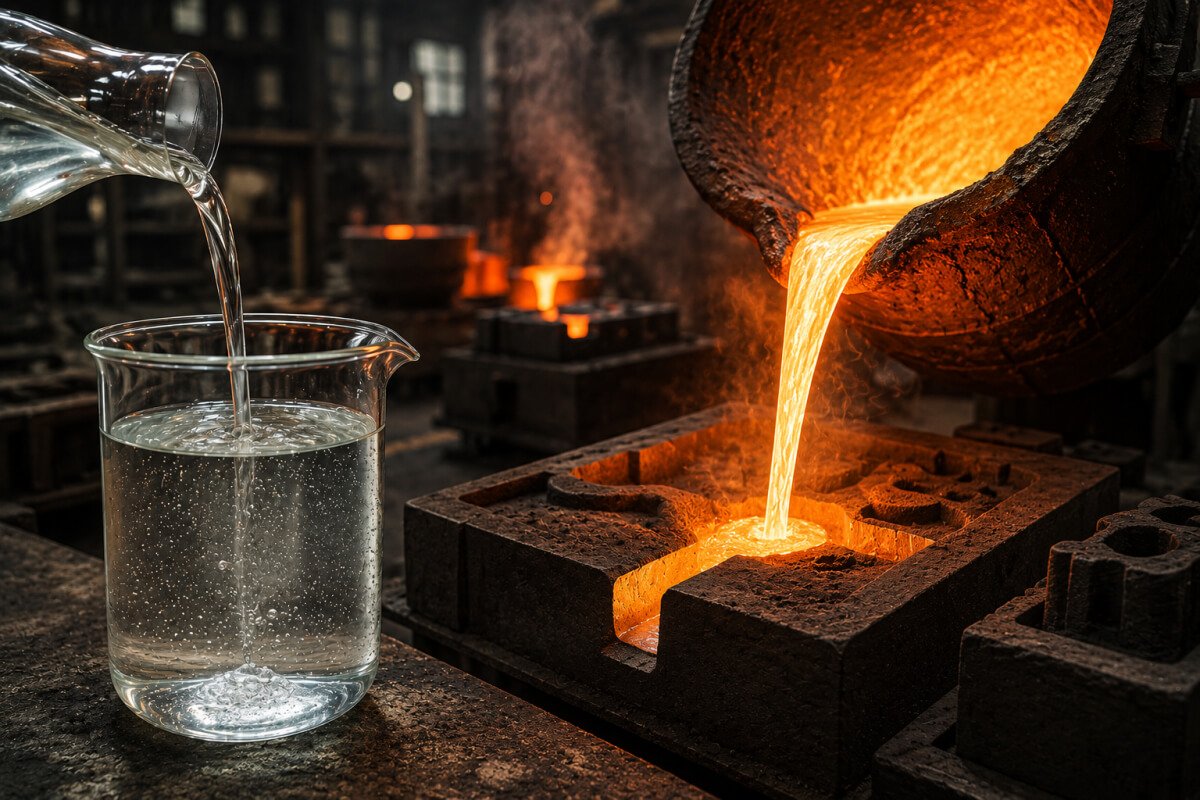
How Sodium Silicate Liquid Is Used in Foundry & Metal Casting Industry
The foundry and metal casting industry is one of the most demanding manufacturing environments in existence. Every day, foundries across India pour molten metal at temperatures exceeding 1,400°C into precisely shaped moulds to produce engine blocks, pump housings, valve bodies, turbine components, and thousands of other critical metal parts. The quality of every casting depends heavily on the integrity of the mould — and that is where sodium silicate liquid plays an irreplaceable role.
For foundry operators, procurement managers, and industrial buyers seeking to buy sodium silicate liquid in India for casting applications, understanding the science behind its function — and why consistent product quality matters — is the first step toward making smarter sourcing decisions. Sri Varahi Chemicals, India’s largest sodium silicate manufacturer and a trusted sodium silicate liquid supplier India foundries rely on, supplies industrial-grade sodium silicate liquid to the metal casting sector with the purity, consistency, and supply reliability that production operations demand.
What Is Sodium Silicate Liquid?
Sodium silicate liquid — commonly known as water glass — is an inorganic compound formed by dissolving silicon dioxide (SiO₂) in sodium oxide (Na₂O) at high temperatures. The resulting solution is characterised by its silica-to-soda ratio (SiO₂:Na₂O), which can be varied during manufacturing to produce grades suited for different industrial applications.
For foundry and metal casting applications, sodium silicate liquid is typically formulated with a silica modulus (SiO₂:Na₂O ratio) in the range of 2.0 to 2.5, and a specific gravity matched to the sand-to-binder requirements of the moulding process in use. These parameters determine the setting speed, green strength, and heat resistance of the mould — all critical performance characteristics in a casting environment.
Core Applications of Sodium Silicate Liquid in Foundry & Metal Casting
1. Sand Binder in CO₂ Moulding Process
The most widely used application of sodium silicate liquid for foundry industry operations is as a sand binder in the CO₂ process. In this method, sodium silicate is mixed with foundry sand — typically silica sand — at a defined ratio (usually 3–6% by weight of sand). The sand-binder mixture is then packed around a pattern to form the mould shape, and carbon dioxide (CO₂) gas is passed through the mould.
The CO₂ reacts with the sodium silicate to form a rigid silica gel structure:
Na₂SiO₃ + CO₂ + H₂O → SiO₂ (gel) + Na₂CO₃
This reaction, known as hardening by gassing, produces a hard, dimensionally stable mould within seconds to minutes — without the need for heat curing. The CO₂ process is valued for its speed, simplicity, dimensional accuracy, and ability to produce complex mould shapes at low tooling cost.
The sodium silicate liquid for foundry applications in the CO₂ process must deliver consistent viscosity, correct SiO₂:Na₂O ratio, and controlled specific gravity to ensure uniform sand mixing and predictable mould hardness across every production run.
2. Core Making for Internal Cavities
Metal castings often require internal passages and cavities — for example, the water jacket in an engine block or the internal bore of a valve body. These internal shapes are created using cores — separate sand-binder shapes that are placed inside the mould before metal is poured.
Sodium silicate-bonded sand is widely used for core making due to its ability to produce dimensionally accurate, rigid cores that withstand the thermal and mechanical stresses of molten metal contact. After casting, sodium silicate-bonded cores have moderate collapsibility — they break down under mechanical vibration or thermal shock during shakeout, allowing the sand to be removed from the casting interior.
For sodium silicate liquid for metal casting core applications, the correct modulus and viscosity are critical to achieving adequate core strength without excessive residual silicate that would make knockout and shakeout difficult.
3. Shell Mould Hardening and Surface Coating
Beyond bulk mould and core applications, sodium silicate liquid is used as a surface hardening agent on moulds produced by other processes. A wash or dip application of sodium silicate followed by CO₂ gassing creates a hard, refractory surface layer on the mould face — improving surface finish of the casting and reducing metal penetration into the sand structure.
This surface treatment is particularly valuable in the production of large castings where surface quality and dimensional accuracy are critical, such as machine tool beds, large pump casings, and heavy engineering components.
4. Refractory Cements and Coatings
Foundries operate high-temperature equipment — furnaces, ladles, runners, and pouring channels — all of which require refractory linings that resist thermal shock and chemical attack from molten metal. Sodium silicate liquid is a key constituent of refractory cements and high-temperature coatings used to line and repair this equipment.
As a high-temperature binder, sodium silicate forms stable silicate bonds at elevated temperatures, providing adhesion and thermal resistance in refractory formulations. This is one of the broader industrial sodium silicate liquid applications that extends beyond moulding into foundry infrastructure maintenance.
5. Investment Casting — Shell Mould Binder
In investment (lost-wax) casting — used extensively for aerospace, automotive, and precision engineering components — sodium silicate liquid serves as a binder in ceramic shell building. The wax pattern is repeatedly dipped in a ceramic slurry and coated with refractory stucco to build up the shell mould. Sodium silicate is incorporated to improve shell green strength and reduce shell cracking during dewaxing and firing.
Investment casting using sodium silicate-bonded shells is widely practised in India for producing precision components in stainless steel, alloy steel, and non-ferrous metals — and the quality of the sodium silicate directly influences shell integrity and casting dimensional accuracy.
Why Product Consistency Is Non-Negotiable in Foundry Applications
In a production foundry, the moulding and core-making process operates at high speed with tight quality control requirements. Any variation in the sodium silicate liquid’s specific gravity, viscosity, or SiO₂:Na₂O ratio changes the behaviour of the sand mix — affecting bench life (the time before the mix starts to set), mould hardness after gassing, and collapsibility after casting.
If the binder is too weak, moulds break during handling or metal runout occurs. If it is too strong, shakeout becomes difficult and casting recovery is compromised. Foundry technicians calibrate their processes around consistent binder performance — which is only possible when the sodium silicate liquid chemical manufacturer they source from maintains tight production controls and delivers the same product specification in every batch and every tanker delivery.
This is why foundries across India consistently prefer sourcing from a certified, large-scale industrial sodium silicate liquid supplier over purchasing from smaller, less-controlled producers.
Sri Varahi Chemicals — The Sodium Silicate Liquid Manufacturer India’s Foundries Trust
Established in 2001 and headquartered in Chennai, Sri Varahi Chemicals is recognised as India’s largest sodium silicate manufacturer — a position built over more than two decades of consistent quality, large-scale production capability, and customer-focused service. With a turnover exceeding ₹500 crores and our own transport infrastructure, we have the scale and operational depth to serve foundries and metal casting operations of every size, from job-shop foundries to large integrated casting facilities.
As a leading sodium silicate liquid bulk supplier and one of the prominent sodium silicate liquid exporters India relies on, we offer:
- Customised sodium silicate liquid formulations — SiO₂:Na₂O ratio, specific gravity, and viscosity tailored to your CO₂ moulding, core-making, or investment casting process
- Consistent batch quality — every delivery rigorously tested against your agreed specification
- High-volume bulk supply capability for continuous production operations — no supply gaps during peak casting seasons
- Reliable on-time delivery through our own logistics fleet — critical for foundries running just-in-time production schedules
- Minimum order quantity from 10 metric tonnes with flexible scheduling for regular supply contracts
- Technical support for foundry engineers specifying binder ratios and application parameters
- Export-ready supply for international foundry customers and trading companies
Whether you are evaluating suppliers for a new foundry setup, reviewing the performance of your current sodium silicate liquid supplier India partner, or scaling up casting capacity, our team is equipped to provide the product quality and supply assurance your operations require.
Take the Next Step
Foundry production cannot afford inconsistent binders. Sri Varahi Chemicals delivers sodium silicate liquid that foundry engineers and procurement teams across India have depended on for over two decades.
To request detailed product specifications, a bulk pricing proposal, or a sample for process trials, contact our team today via our Contact Page. We respond promptly and are ready to support both domestic foundry customers and international buyers.
Sri Varahi Chemicals — India’s trusted sodium silicate liquid manufacturer, delivering the consistency and reliability that precision metal casting demands.