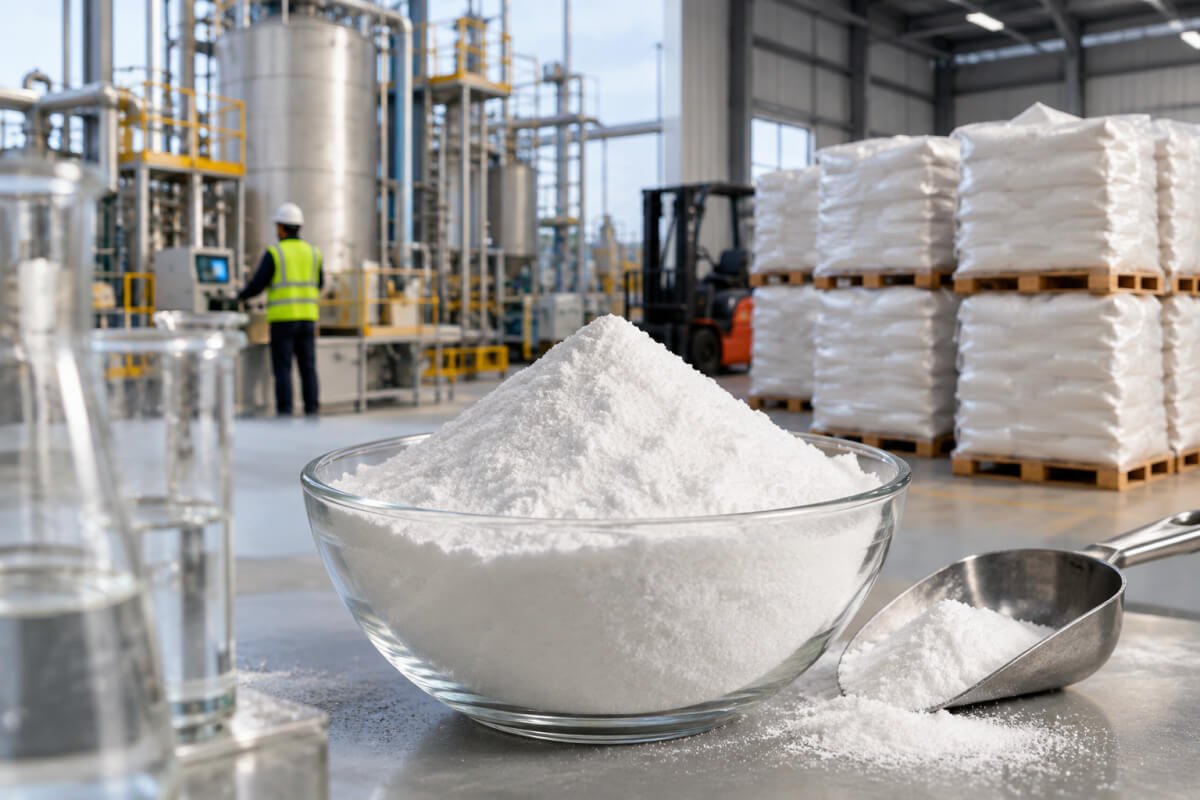
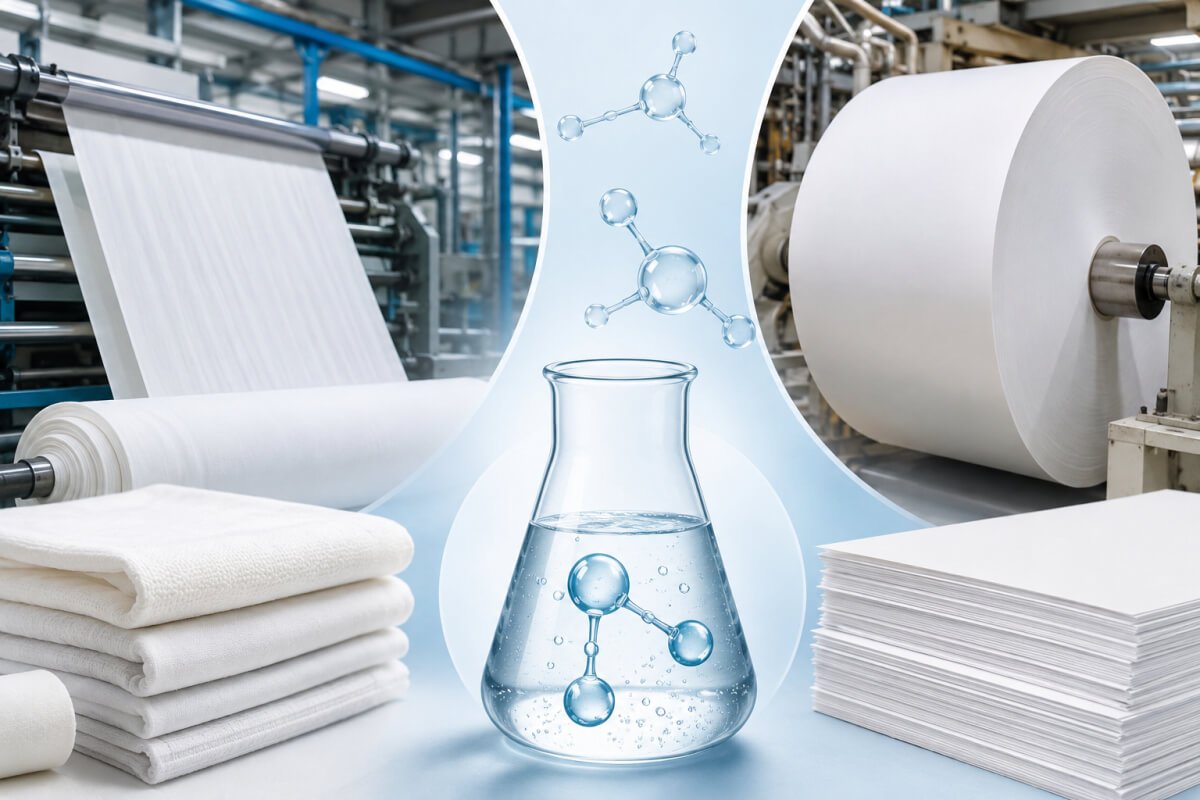
In both the textile and paper industries, whiteness is not simply an aesthetic preference — it is a functional specification. A bright white fabric accepts dyes more uniformly and produces truer, more vibrant colours. A high-brightness paper sheet delivers sharper print contrast, better opacity, and higher perceived quality. Achieving that whiteness at commercial scale, consistently and cost-effectively, requires the right bleaching agent — and across both industries, hydrogen peroxide has established itself as the bleaching agent of choice for modern, environmentally responsible manufacturing.
For textile mills, paper manufacturers, and industrial buyers looking to buy hydrogen peroxide in India for bleaching applications, understanding how and why hydrogen peroxide works — and what quality parameters govern its performance — is essential to maximising both process efficiency and product quality. Sri Varahi Chemicals, a trusted hydrogen peroxide manufacturer in India, supplies high-purity, industrial-grade hydrogen peroxide to textile and paper industries across India and international markets with the consistency and supply reliability that continuous production demands.
What Is Hydrogen Peroxide and Why Is It the Preferred Bleaching Agent?
Hydrogen peroxide — chemical formula H₂O₂ — is a pale blue, water-miscible liquid that acts as a powerful oxidising agent. Its bleaching action is based on the release of active oxygen in alkaline conditions, which breaks down chromophoric groups — the chemical structures responsible for colour in natural fibres and wood pulp — through oxidation.
H₂O₂ → H₂O + [O] (active oxygen)
What makes hydrogen peroxide the dominant hydrogen peroxide bleaching agent in modern industrial practice is not just its bleaching effectiveness — it is the combination of effectiveness with environmental acceptability. Unlike chlorine-based bleaches such as sodium hypochlorite and chlorine dioxide, hydrogen peroxide leaves no chlorinated organic residues (AOX — adsorbable organic halides) in the effluent. Its decomposition products are simply water and oxygen — making it a genuinely clean chemistry that aligns with tightening environmental regulations and sustainability commitments across both industries.
Hydrogen Peroxide in the Textile Industry
1. Cotton Scouring and Bleaching — Combined Process
The pre-treatment of grey cotton fabric before dyeing involves removing natural impurities — waxes, pectins, oils, seed coat fragments, and natural colouring matter — that would otherwise interfere with dye uptake and produce uneven, poorly fast shades. Traditionally, this involved separate scouring and bleaching stages. Modern textile mills increasingly use hydrogen peroxide for textile bleaching in a combined scour-bleach process that delivers both cleaning and whitening in a single bath.
In this process, hydrogen peroxide at concentrations of 3–8 g/L is applied alongside caustic soda (which activates the peroxide by creating alkaline conditions), sodium silicate or magnesium sulphate as stabilisers, and a wetting agent. At temperatures of 90–100°C — or 70–80°C in low-temperature formulations — the activated peroxide destroys the natural colour bodies in cotton, delivering ISO whiteness levels of 80–85% suitable for dyeing or further optical brightening.
Hydrogen peroxide for textile industry bleaching is used across all cotton processing formats — open-width fabric, rope, yarn packages, loose fibre, and knitted goods — using batch, semi-continuous (pad-batch), or continuous (J-box or steamer) processing equipment. The versatility of peroxide bleaching across equipment types and fabric forms is one of its key advantages over alternative bleaching systems.
2. Wool and Protein Fibre Bleaching
Wool, silk, and other protein fibres cannot be bleached with chlorine-based agents without severe and irreversible fibre damage. Hydrogen peroxide is the only viable bleaching agent for protein fibres at commercial scale. Wool bleaching with hydrogen peroxide is carried out under mildly alkaline or neutral conditions at moderate temperatures (50–60°C), preserving fibre strength and handle while delivering the brightness levels required for white and pale-dyed products.
For specialty applications — particularly white wool for high-value apparel and fine yarn production — careful control of hydrogen peroxide concentration, pH, temperature, and time is essential to achieve the target whiteness without tensile strength loss. The purity of the industrial hydrogen peroxide supplier’s product is especially critical here, as heavy metal contaminants (iron, manganese, copper) catalyse uncontrolled peroxide decomposition that generates fibre-damaging radicals.
3. Synthetic Fibre and Blended Fabric Bleaching
Polyester, nylon, and polyester-cotton blends also use hydrogen peroxide in pre-treatment. For polyester, it is used to remove optical brightening agents and carrier chemicals applied during texturising or false-twist processes. For blended fabrics, peroxide bleaching addresses the cotton component while leaving the synthetic component unaffected — making it the only practical bleaching system for mixed-fibre substrates that must achieve uniform whiteness across both fibre types.
4. Denim and Garment Finishing
In denim finishing, hydrogen peroxide plays an increasingly important role in sustainable stone-wash and acid-wash replacement processes. Peroxide-based enzymatic bleaching systems are used to achieve the faded, worn appearance demanded by fashion markets without the potassium permanganate (KMnO₄) spraying that was the traditional approach — eliminating manganese from effluent streams and reducing the environmental and health risks associated with that chemistry.
Hydrogen Peroxide in the Paper and Pulp Industry
1. Mechanical Pulp Bleaching — The Primary Application
Hydrogen peroxide for paper industry applications is most extensively used in the bleaching of mechanical and chemothermomechanical pulp (CTMP). Unlike chemical pulps (kraft or sulphite), which are delignified through chemical cooking, mechanical pulps retain most of the wood’s lignin — which gives them high yield but also a pronounced tendency to yellow over time (newsprint yellowing is a familiar example).
Hydrogen peroxide bleaching of mechanical pulp works through the oxidation of chromophoric lignin groups — the specific chemical structures in lignin that absorb visible light and produce the yellow-brown colour. This oxidative modification brightens the pulp without dissolving the lignin, preserving pulp yield while delivering ISO brightness levels in the range of 70–80% — suitable for newsprint, magazine paper, directory paper, and tissue.
The peroxide bleaching stage for mechanical pulp uses hydrogen peroxide at 1–4% on oven-dry pulp weight, applied under alkaline conditions (pH 10–11, using NaOH and sodium silicate as stabiliser) at temperatures of 60–75°C with residence times of 60–180 minutes. The economics of this process are highly sensitive to peroxide consumption efficiency — which in turn depends directly on the purity and stability of the hydrogen peroxide supply.
2. Chemical Pulp Brightening — ECF and TCF Sequences
In modern kraft pulp bleaching sequences — whether Elemental Chlorine Free (ECF) or Totally Chlorine Free (TCF) — hydrogen peroxide is used as a brightening and residual lignin removal stage. In ECF sequences, it typically appears as a Peroxide (P) or Alkaline Peroxide Extraction (Ep) stage following chlorine dioxide stages. In TCF sequences, peroxide stages carry a larger bleaching burden and are combined with ozone, peracetic acid, or oxygen stages.
In chemical pulp applications, hydrogen peroxide is used at high concentrations (5–15 kg/tonne of pulp) under high-consistency (30–35%) conditions — a process that requires high-purity, stabilised peroxide with minimal catalytic decomposition to achieve target brightness gains efficiently.
3. Recycled Fibre and Recovered Paper Brightening
In recycled fibre processing, hydrogen peroxide is used in deinking and flotation circuits to arrest the re-yellowing of recovered mechanical pulp fibres and to brighten the cleaned pulp furnish before sheet formation. As environmental regulation drives paper mills toward higher recycled content targets, the role of hydrogen peroxide in maintaining acceptable brightness in recycled-content papers is growing steadily.
Why Hydrogen Peroxide Quality Determines Bleaching Performance
In both textile and paper bleaching, the performance of hydrogen peroxide is directly linked to its purity and stability. The key quality parameters assessed by industrial users are:
Active Oxygen Content (concentration): Industrial hydrogen peroxide is supplied at 35%, 50%, or 60% concentration by weight. The actual H₂O₂ assay must be consistent and accurately declared — under-strength product delivers lower brightness at higher cost per effective unit.
Stabiliser Package: Commercial hydrogen peroxide contains stabilisers — typically phosphonate or stannate-based — that suppress catalytic decomposition during storage and transport. A well-stabilised product delivers consistent performance from the first delivery to the last drum of the batch.
Heavy Metal Content: Trace levels of iron, manganese, and copper catalyse the decomposition of H₂O₂ into hydroxyl radicals that cause uncontrolled fibre damage in textile bleaching and unproductive peroxide consumption in paper bleaching. The hydrogen peroxide chemical manufacturer’s heavy metal specifications are therefore a primary quality selection criterion for both industries.
Acidity (pH and free acid content): Excessively acidic product can interfere with the alkaline bleaching conditions required in both textile and paper applications, requiring additional alkali consumption to achieve the target pH.
This is why industrial procurement teams across India consistently seek a reliable hydrogen peroxide bulk supplier who guarantees consistent concentration, purity, and stabiliser performance across every delivery — not just the initial qualification batch.
Sri Varahi Chemicals — Your Trusted Hydrogen Peroxide Supplier India
Headquartered in Chennai and operating since 2001, Sri Varahi Chemicals is a well-established name in industrial chemical manufacturing and supply, with a turnover exceeding ₹500 crores. As a dependable hydrogen peroxide supplier India textile mills and paper manufacturers rely on, we supply industrial-grade hydrogen peroxide in the concentrations and volumes that continuous production operations require — backed by our own logistics infrastructure and rigorous quality management.
As a committed hydrogen peroxide bulk supplier, we offer:
- Industrial-grade hydrogen peroxide at 35%, 50%, and 60% concentrations with consistent assay and stabiliser performance
- Bulk supply capability for textile mills, paper and pulp mills, and chemical processors running continuous bleaching operations
- Reliable on-schedule delivery through our own transport fleet — critical for mills with no buffer stock capacity
- Rigorous batch quality documentation — concentration assay, heavy metals, acidity, and stabiliser content per delivery
- Competitive bulk pricing with transparent, long-term supply arrangements for major industrial consumers
- Safe handling and transportation in compliance with hazardous chemical transport regulations for peroxide supply
Whether you are a cotton mill pre-treatment manager evaluating your current supply chain, a paper mill procurement team reviewing peroxide suppliers, or a chemical distributor looking for a dependable hydrogen peroxide chemical manufacturer partner, our team is equipped to meet your requirements.
Start a Conversation With Our Team
Consistent bleaching performance starts with consistent hydrogen peroxide quality. Sri Varahi Chemicals delivers industrial hydrogen peroxide that textile and paper operations across India count on.
To request product specifications, concentration and purity datasheets, or a bulk pricing proposal, reach out to our team via our Contact Page today. We support both domestic industrial buyers and international customers promptly.
Sri Varahi Chemicals — A trusted hydrogen peroxide manufacturer delivering bleaching-grade quality and supply reliability that India’s textile and paper industries depend on.