China clay — also known as kaolin clay — is one of the most critical raw materials in the ceramics and tile manufacturing industry. Its unique combination of fine particle size, high whiteness, excellent plasticity, and thermal stability makes it irreplaceable in producing everything from floor tiles and wall tiles to porcelain, sanitaryware, and decorative tableware. For manufacturers looking for a reliable ceramic grade china clay supplier, understanding how this mineral functions within ceramic bodies and glazes is essential to achieving the right product quality, finish, and structural integrity.
In this article, we explore the specific role china clay plays in ceramics and tile production, why its quality matters, and what to look for when sourcing it for your manufacturing operations.
What Is China Clay and Why Does It Matter in Ceramics?
China clay is a naturally occurring mineral — a hydrated aluminium silicate with the chemical formula Al₂Si₂O₅(OH)₄. It is formed through the weathering of feldspar-rich rocks over millions of years and is extracted from deposits found across several regions in India, particularly in Rajasthan, Gujarat, Kerala, and Jharkhand.
What makes china clay indispensable to the ceramics industry is its mineral composition. It has a fine, plate-like particle structure that gives ceramic bodies their plasticity during shaping, and it contributes alumina (Al₂O₃) to the fired product, which is responsible for the mechanical strength and thermal resistance of the finished tile or ceramic piece.
As a trusted china clay manufacturer in India, Sri Varahi Chemicals sources kaolin from carefully selected deposits and processes it using advanced beneficiation techniques to deliver material with consistent whiteness, controlled particle size, and minimal impurities — all of which are non-negotiable for ceramic-grade applications.
How China Clay Is Used in Tile Manufacturing
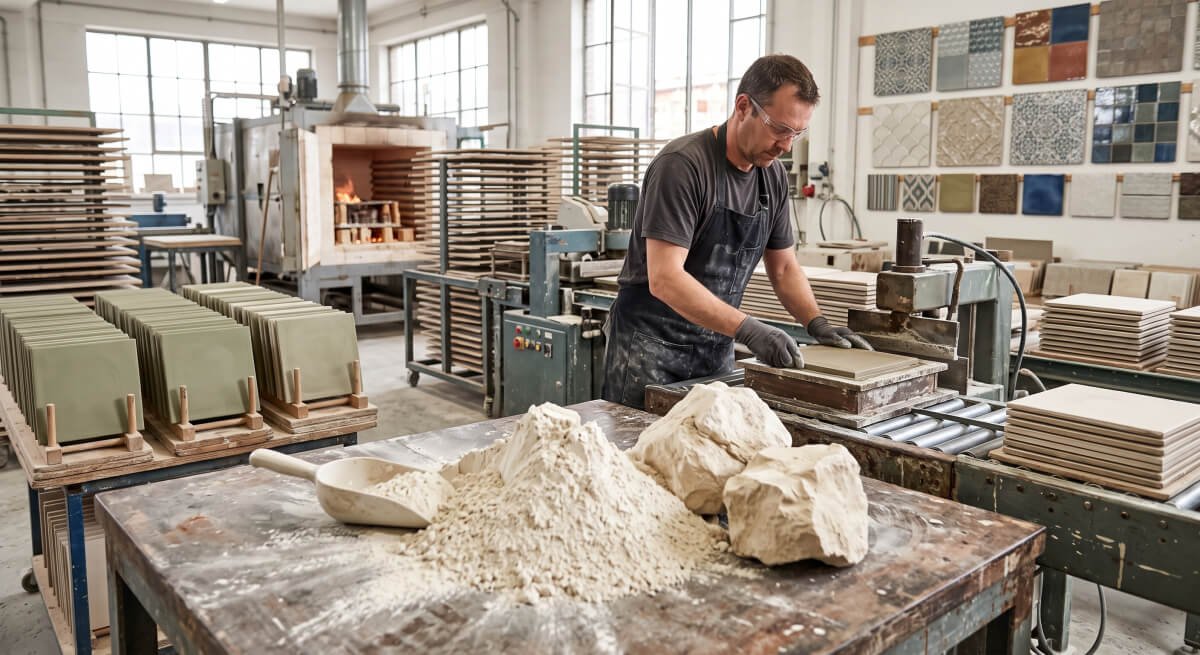
The tile manufacturing process involves several stages — body preparation, pressing, drying, glazing, and firing. China clay for tile manufacturing contributes meaningfully at almost every stage.
Body Formulation and Plasticity: The ceramic body, or “green body,” is the unfired mixture of minerals that forms the tile. China clay is a primary component of this mixture, typically making up 20 to 35 per cent of the body composition depending on the tile type. Its role here is twofold. First, it provides the plasticity needed to shape the body during pressing or extrusion. Without adequate plasticity, the green body would crack, crumble, or fail to hold its form. Second, it acts as a binding agent that holds the other non-plastic components — such as quartz, feldspar, and ball clay — together during the forming stage.
Whiteness and Colour Control: The brightness and whiteness of china clay directly influence the base colour of the tile body. High-quality china clay powder with low iron content produces a clean, white base that allows glazes, prints, and decorative finishes to appear vivid and true to colour. This is particularly important for manufacturers of polished vitrified tiles, white porcelain, and premium wall tiles where aesthetics are a selling point.
Strength After Firing: During the firing process, which typically occurs at temperatures between 1000°C and 1250°C, china clay undergoes a series of chemical transformations. It first loses its chemically bound water, then converts into metakaolin, and eventually forms mullite — a highly stable crystalline phase that gives the fired tile its mechanical strength, hardness, and resistance to thermal shock. The higher the alumina content in the china clay, the more mullite is formed, resulting in stronger and more durable tiles.
Controlled Shrinkage: All ceramic bodies shrink during drying and firing. The grade and particle size of china clay used in the formulation directly affect the rate and uniformity of this shrinkage. A well-processed, consistent china clay ensures predictable shrinkage behaviour, reducing the risk of warping, cracking, or dimensional inconsistency in the final product — a critical quality parameter for large-format tiles and precision-cut pieces.
China Clay in Ceramic Glazes and Engobes
Beyond the tile body itself, china clay for the ceramic industry is also an essential ingredient in glazes and engobes — the coating layers that give tiles their surface finish, colour, and protective properties.
In glazes, kaolin serves as a suspension agent, keeping the other glaze components evenly distributed in the liquid slurry and preventing settling. It also contributes alumina to the glaze chemistry, which increases the glaze’s viscosity during firing and prevents it from running off the tile surface. This ensures a smooth, even coating with consistent thickness across the tile.
In engobes — the intermediate coating applied between the body and the glaze — china clay improves adhesion, controls opacity, and enhances the smoothness of the surface before the final glaze is applied. This is especially important in digital printing applications, where a uniform engobe surface is necessary for high-resolution printed designs.
Why Quality and Grade Selection Matter
Not all china clay is suitable for ceramics and tile manufacturing. The performance of the final product depends heavily on the mineral purity, particle size distribution, brightness index, and iron oxide content of the china clay used.
Ceramic grade china clay must have high alumina content to ensure adequate mullite formation and post-firing strength. It must also have low iron oxide (Fe₂O₃) levels — ideally below 1 per cent — to prevent unwanted discolouration or dark speckling in the tile body and glaze. Fine and uniform particle size is critical for consistent plasticity, smooth surface finish, and predictable firing behaviour. Low moisture content is equally important for efficient processing and to avoid defects during pressing and drying.
Manufacturers who compromise on china clay quality often face issues such as inconsistent shrinkage, surface defects, low mechanical strength, and colour variation across batches — all of which lead to higher rejection rates and increased production costs.
This is also why many ceramic manufacturers who use china clay also source complementary minerals like bentonite from the same supplier. Bentonite is used in smaller quantities as a plasticiser and binding agent in ceramic bodies, and sourcing both from a single reliable supplier ensures consistent mineral compatibility across the formulation.
India’s Growing Ceramics Industry and the Demand for Quality Kaolin
India is one of the largest ceramic tile producers in the world, with major manufacturing clusters in Gujarat (Morbi), Rajasthan, and Andhra Pradesh. As the industry continues to expand — driven by growing construction activity, urbanisation, and export demand — the need for high-quality, consistently graded kaolin has risen sharply.
This growth has also pushed manufacturers to look beyond basic raw material procurement and seek kaolin clay suppliers in India that can provide technical support, customised grades, and reliable bulk supply without disruption. The difference between a commodity supplier and a strategic partner often comes down to consistency — whether every truckload of china clay that arrives at the factory floor meets the same specifications as the last.
China clay exporters India relies on are also serving growing international demand from markets in the Middle East, Africa, and South-East Asia, where ceramic manufacturing capacity is expanding rapidly.
For a deeper understanding of how china clay performs in other coating applications, you may also find it useful to read about why china clay is preferred in the paint and coatings industry, where many of the same mineral properties — whiteness, particle fineness, and chemical inertness — are equally valued.
Why Ceramic Manufacturers Trust Sri Varahi Chemicals
Sri Varahi Chemicals has operated as a dependable industrial china clay supplier and kaolin clay manufacturer in India for over 25 years. The company supplies washed china clay, china clay powder, and china clay lumps in grades specifically processed for the ceramics, tile, sanitaryware, and porcelain industries.
Every batch is tested for alumina content, brightness, particle size, moisture, and iron oxide levels to ensure it meets the demanding specifications of modern ceramic production lines. With ISO-certified quality assurance, a distribution network spanning major industrial hubs across India, and export-grade packaging for international shipments to over 40 countries, Sri Varahi Chemicals offers the reliability, consistency, and scale that ceramic manufacturers need.
Whether you are looking to buy china clay in bulk for a large tile manufacturing plant or need a customised grade for a speciality ceramic application, the team at Sri Varahi Chemicals can help you select the right material for your process.
Get in touch today for bulk quotations, technical specifications, or a consultation on the ideal china clay grade for your production requirements.