
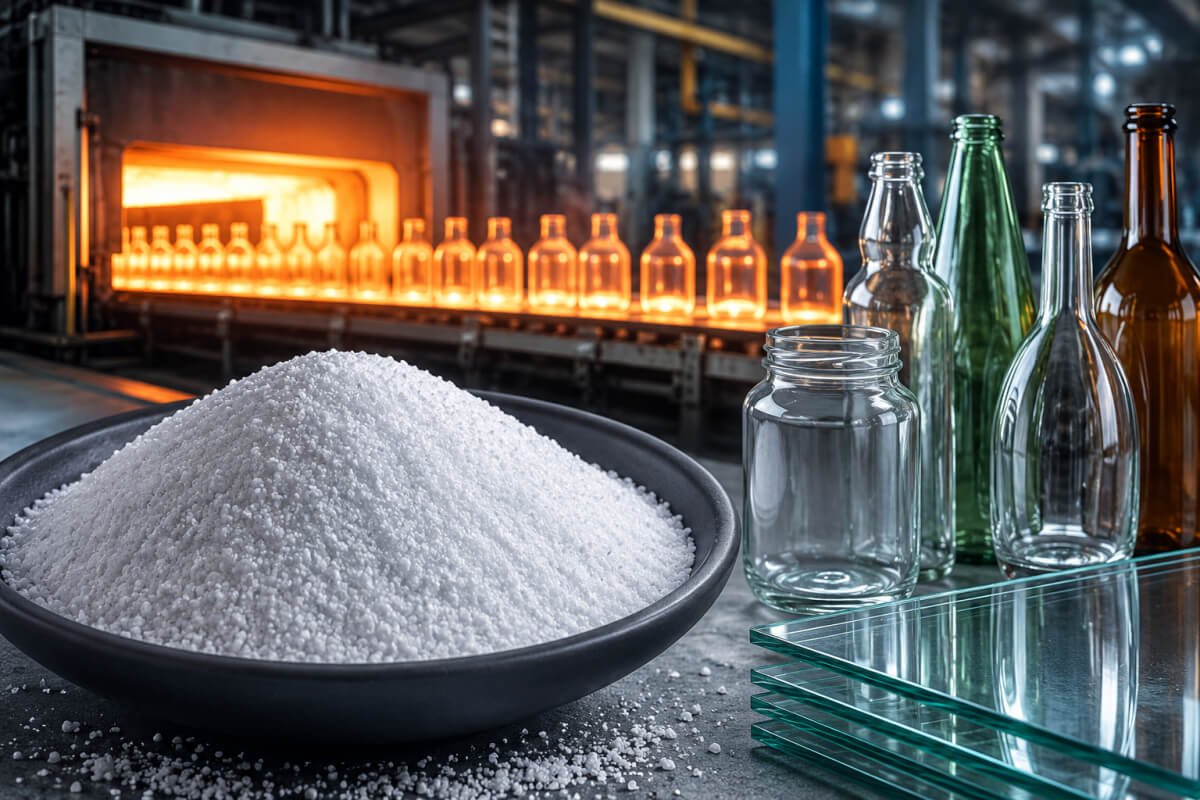
Why Soda Ash Dense Is a Key Raw Material in Glass Manufacturing
Glass is all around us — in the windows of our homes and offices, in the bottles and jars that store our food and beverages, in the windshields of every vehicle on the road, and in the precision optics that power everything from cameras to scientific instruments. Yet very few people pause to consider what makes glass production possible at a commercial scale. At the heart of every glass melt is a small group of critical raw materials, and soda ash dense is one of the most important among them.
For glass manufacturers, procurement teams, and industrial buyers looking to buy soda ash dense in India for large-scale production, understanding the chemistry and the stakes of raw material quality is essential. Sri Varahi Chemicals, a trusted soda ash dense manufacturer in India, supplies high-purity, industrial-grade soda ash dense to glass manufacturers across India and international markets — with the consistency and reliability that large-scale production demands.
What Is Soda Ash Dense?
Soda ash dense is the granular form of sodium carbonate (Na₂CO₃), distinguished from soda ash light by its significantly higher bulk density — typically between 1,000 and 1,200 kg/m³ compared to 400–500 kg/m³ for the light grade. This higher density gives it superior handling characteristics: lower dust generation, reduced segregation in batch mixes, and more stable volumetric feeding in automated raw material systems.
These physical properties make soda ash dense the overwhelmingly preferred choice for soda ash dense for glass manufacturing — an application where raw materials are batched, blended, and fed into high-temperature furnaces in very large, precisely controlled quantities around the clock.
The Role of Soda Ash Dense in Glass Melting
Glass is fundamentally a supercooled liquid composed primarily of silicon dioxide (SiO₂), derived from silica sand. However, pure silica has an extremely high melting point — approximately 1,700°C — making it energy-prohibitive to melt in its pure state at industrial scale. This is where soda ash dense becomes indispensable.
1. Acting as a Flux — Reducing the Melting Point
The primary function of soda ash dense for glass industry applications is as a flux. When sodium carbonate is introduced into the glass batch, it decomposes at furnace temperatures to release sodium oxide (Na₂O), which acts as a network modifier in the silica structure. This disrupts the tightly bonded silicon-oxygen network, dramatically lowering the melting point of the batch to a more manageable 1,400–1,500°C range.
This reduction in melting temperature translates directly into lower energy consumption per tonne of glass produced — a significant operational cost advantage given the energy intensity of glass manufacturing. Without soda ash, glass manufacturing at commercial scale would simply not be economically viable.
2. Improving Melt Homogeneity
Soda ash dense water also plays a key role in improving the homogeneity of the glass melt. As sodium carbonate decomposes and releases CO₂ gas, the resulting bubbling action helps stir and mix the molten batch — promoting uniform distribution of all components and reducing the likelihood of unmelted inclusions or composition gradients in the finished glass.
Uniform melt chemistry is critical for glass quality. Inhomogeneity leads to visual defects such as striae (streaks), seeds (tiny bubbles), and stones (unmelted particles) — all of which are unacceptable in flat glass, container glass, and specialty optical glass production.
3. Controlling Glass Properties
The amount of Na₂O incorporated into the glass network — ultimately derived from soda ash dense — directly influences key glass properties including viscosity, thermal expansion coefficient, chemical durability, and electrical resistivity. Glass formulators carefully control the soda ash proportion in the batch recipe to achieve the target specification for each glass product type.
For example, container glass and flat glass typically contain 12–15% Na₂O by composition. Any variation in the Na₂CO₃ content of the soda ash supply will shift the actual Na₂O incorporation in the melt, causing off-specification glass that may fail strength, thermal, or optical tests.
Soda Ash Dense Industrial Applications Across Glass Segments
Flat Glass (Float Glass)
The flat glass segment — which produces glass for construction, automotive, and solar panel applications — is the single largest consumer of soda ash dense globally. Float glass furnaces run continuously and consume hundreds of tonnes of raw materials every day. The soda ash dense industrial applications in this segment demand absolute consistency in chemical purity, particle size distribution, and moisture content to ensure stable furnace performance and consistent glass composition.
Container Glass
Bottles, jars, pharmaceutical vials, and food-grade glass containers are produced in container glass furnaces. Here too, soda ash dense is a core batch component. Fluctuations in Na₂CO₃ content affect melt viscosity and forming behaviour, which in turn impacts wall thickness uniformity, bottle weight, and defect rates on high-speed forming lines.
Specialty and Technical Glass
Borosilicate glass, optical glass, laboratory glassware, and glass fibre all incorporate soda ash dense in carefully controlled proportions. These specialty applications often have tighter composition tolerances than commodity glass, making raw material consistency even more critical.
Glass Wool and Fibre Glass
Thermal and acoustic insulation products made from glass wool also rely on soda ash dense as a batch component. The controlled alkalinity and flux action of soda ash enables the low-viscosity melts needed to produce the fine glass fibres used in insulation manufacturing.
Why Raw Material Quality Directly Impacts Glass Production
In glass manufacturing, the furnace is the bottleneck. It runs continuously — 24 hours a day, 365 days a year — and cannot be stopped without incurring enormous costs. Any disruption to raw material quality that affects melt behaviour can take hours or days to stabilise, during which time off-specification glass is produced and potentially scrapped.
Key quality parameters that glass manufacturers specify when sourcing from an industrial soda ash dense supplier include:
- Na₂CO₃ content — typically 99.2% or higher for industrial glass grade
- Moisture content — must be minimal to prevent batch caking and handling issues
- Bulk density — must fall within the specified range for accurate volumetric batching
- Particle size distribution — must match the furnace batch system specifications
- Iron and heavy metal content — critical for colourless and optical glass grades
Sourcing from a certified soda ash dense chemical manufacturer with rigorous quality control at every production stage is therefore not optional — it is a fundamental requirement for any serious glass manufacturer.
Sri Varahi Chemicals — Your Trusted Soda Ash Dense Supplier India
Headquartered in Chennai with over two decades of industrial chemical manufacturing experience, Sri Varahi Chemicals has established itself as a dependable name among soda ash dense exporters India and the broader industrial chemicals market. With a turnover exceeding ₹500 crores and a strong nationwide and international distribution network, we supply glass manufacturers, chemical processors, and industrial distributors with high-purity soda ash dense that meets stringent quality specifications.
As a leading soda ash dense bulk supplier, we offer:
- High-purity soda ash dense with consistent Na₂CO₃ content, controlled bulk density, and low moisture
- Large-volume bulk supply capability for flat glass, container glass, and specialty glass manufacturers
- Reliable, on-schedule delivery backed by our own logistics infrastructure — critical for continuous-process industries like glass
- Flexible packaging options for domestic bulk buyers and export shipments
- Competitive pricing with transparent, long-term supply arrangements
- Technical support for procurement teams specifying raw material quality parameters
Whether you are a glass manufacturer scaling up production, a trading company sourcing for export, or a procurement manager reviewing your current soda ash dense supplier India relationship, our team is ready to discuss your requirements and provide the supply assurance your operations need.
Start a Conversation With Our Team
Reliable raw material supply is the foundation of uninterrupted glass production. Sri Varahi Chemicals is committed to being a supplier you can count on — not just for the first order, but for every delivery that follows.
To request product specifications, a bulk pricing proposal, or a sample for quality evaluation, reach out to us via our Contact Page. Our team responds promptly and is equipped to support both domestic and international buyers.
Sri Varahi Chemicals — A trusted soda ash dense manufacturer delivering industrial-grade quality that glass manufacturers across India and beyond rely on.